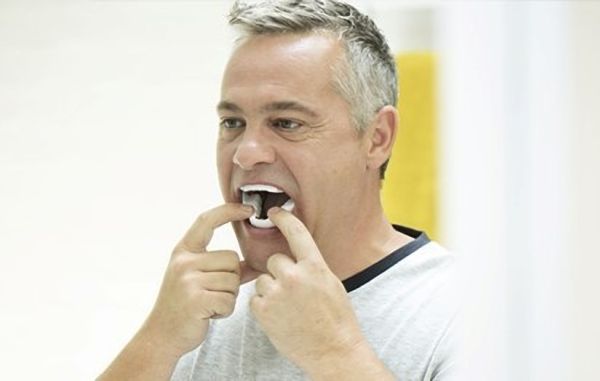
The anti-apnoea and snoring orthosis: a treatment for you?
The anti-apnoea and snoring orthosis is an intraoral device designed for adults seeking a solution to treat their loud snoring. Clinically proven, it is also a treatment for patients suffering from obstructive sleep apnoea. It is indicated as a first-line treatment for mild to moderate apnoea and as an alternative to CPAP treatment in cases of failure, refusal or intolerance to CPAP treatment in cases of severe obstructive apnoea.
The anti-apnoea and snoring orthosis: a practical treatment
- Custom-made: The anti-apnoea and snoring orthosis is designed based on dental impressions taken by your oral health specialist (doctor, dentist) and any other dental characteristics they specify, which will be taken into account in the design of the orthosis.
- Thin and comfortable: Small and discreet for comfortable treatment. It is designed to take up as little space as possible in your mouth.
- Strong and durable: It has been designed to withstand forces similar to those generated by bruxism.
Snoring is linked to a narrowing of the airways, caused by several factors, the main ones being excess weight and loosening of the throat tissues. Snoring is usually harmless, but it can be a significant social nuisance or a symptom of sleep apnoea.
Wearing a dental appliance is a painless and practical solution for combating snoring.
How dental splints work
A dental splint (or prosthesis) is worn every night to hold the lower jaw and tongue forward.
This increases the diameter of the airways and facilitates airflow. This device is also called a mandibular advancement splint.
Especially in patients with apnoea, the appliance must be custom-made by a dentist (when fitted, the mandibular advancement is usually set at around 60% of the maximum advancement) after a complete dental examination.
The assessment by the dentist or orthodontist at the Brussels Smile Clinic allows them to check the condition of the temporomandibular joint, in particular to verify the ability to move the jaw forward, and to carry out an oral examination with a panoramic dental X-ray to check for any contraindications (teeth capable of supporting the brackets, periodontium without significant bone resorption, as otherwise the appliance could mobilise the teeth).
It is fairly discreet (some, such as anti-apnoea and anti-snoring appliances, are very compact) but not everyone tolerates it well. For some people, mandibular advancement devices cause discomfort and interfere with sleep, while others find them very comfortable and effective. It is also common for patients to experience temporary dry mouth or hypersalivation, discomfort when chewing, and, above all, changes in occlusion upon waking.
The device should be inserted half an hour before bedtime.
Please note that the device can be adjusted if discomfort persists after the first few nights. This usually requires two appointments with the dentist within a month.
Anti-apnoea and snoring orthosis: get back to a good night's sleep
89% of patients who wear the CC anti-apnoea and snoring orthosis stop snoring after 3 months of treatment.
What's more, 79% of patients who wore the anti-apnoea and snoring appliance to combat their sleep apnoea — including those suffering from the most severe forms of obstructive sleep apnoea syndrome (OSAS) — saw a reduction of more than 50% in their AHI (apnoea/hypopnoea index) after 3 months.
For further information, please contact the Brussels Smile Clinic on 02 608 26 71.